
On April 20, 2026, Italian energy giant Eni officially announced a giant natural gas exploration breakthrough at the Geliga-1 exploration well in the Ganal Block of the Kutai Basin, offshore East Kalimantan, Indonesia. Preliminary estimates indicate that the major discovery holds approximately 5 trillion cubic feet (Tcf) of natural gas and around 300 million barrels of condensate. The massive oil and gas resources obtained from this exploration, combined with successive regional exploration results, hub development plans, and cross-border asset integration, mark an important milestone in deepwater oil and gas exploration. They also bring new increments to the overseas upstream portfolio of its partner Sinopec.
1. Deepwater Major Discovery
The Geliga-1 giant gas discovery is located in deep waters approximately 70 km off the coast of East Kalimantan, Indonesia, at an operating water depth of about 2,000 meters. The exploration well reached a total depth of 5,100 meters and encountered a large high-quality gas column in the target Miocene strata. The reservoir exhibits excellent petrophysical properties, laying a solid geological foundation for subsequent efficient development. A drill stem test (DST) will be carried out in the next phase to accurately determine reservoir productivity parameters.
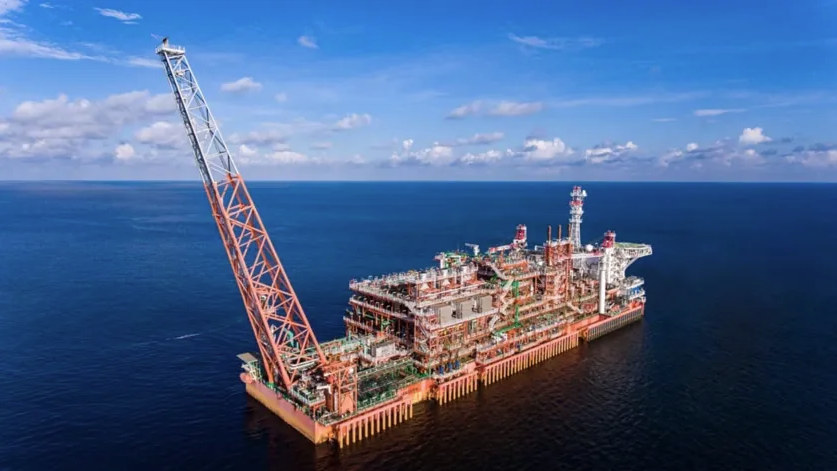
The Geliga-1 discovery is not an isolated exploration result, but rather a continuous breakthrough from Eni’s sustained and progressive exploration efforts in the Kutai Basin. Previously, significant oil and gas discoveries have been made successively in this region: the giant Geng North gas field was discovered 20 km south of the Geliga well at the end of 2023, and another exploration breakthrough at the Konta-1 well was announced in December 2025. This series of consecutive discoveries has validated the enormous resource potential and substantial scalability of reserves in the deep formations of the Kutai Basin.
According to information disclosed on Eni’s official website, the gas reservoir is located within the Ganal Production Sharing Contract (PSC) block operated by Eni, where Eni holds an 82% operating interest and Sinopec holds an 18% participating interest. The block’s asset ownership is unique: it is one of the core assets that Eni plans to inject into Searah, a joint venture with Petronas. This joint entity comprises 19 oil and gas blocks globally (14 in Indonesia and 5 in Malaysia). The collaboration was officially announced in November 2025, with asset completion expected in the second quarter of 2026. The overall integrated discovered resources amount to approximately 3 billion barrels of oil equivalent, while also unlocking significant untapped exploration potential.
As the core hydrocarbon-bearing basin in Indonesia, the Kutai Basin holds over 90% of the country’s proven commercial oil and gas reserves. This new discovery further unlocks the deep exploration potential of the basin. Combined with previous breakthroughs at Geng North, Konta-1, and other gas reservoirs, the basin has formed a multi-point, contiguous exploration and development pattern, providing a solid resource base for large-scale natural gas production capacity release.
Eni has already completed Final Investment Decisions (FID) for two major hub projects: the Gendalo-Gandang Southern Hub and the Geng North-Gehem Northern Hub. The Northern Hub will be equipped with a new floating production, storage, and offloading (FPSO) unit, designed to handle 1 billion standard cubic feet per day of natural gas and 90,000 barrels per day of condensate. It will also be linked to the existing Bontang LNG liquefaction plant for resource export. In terms of coordinated resource development, Geliga-1 and the adjacent undeveloped Gula gas field—which holds 2 trillion cubic feet of natural gas and 75 million barrels of condensate—will form a high-quality resource synergy. Preliminary estimates show that joint development of the two blocks could add 1 billion standard cubic feet per day of natural gas and 80,000 barrels per day of condensate, creating favorable conditions for rapidly establishing a third large-scale production hub in the Kutai Basin. At the same time, Eni is conducting special studies to expand the liquefaction capacity of the Bontang LNG plant and extend its operational life, reinforcing the Kutai Basin’s position as a core LNG supply hub in Southeast Asia. For Eni, this resource increment will enhance its upstream portfolio in Southeast Asia and empower the Searah joint venture to achieve a stable production target of 500,000 barrels of oil equivalent per day in the medium term and become a regional mainstream LNG supplier.
2. Sinopec and Eni: Tied Together for Synergistic Progress
The cooperation between Sinopec and Eni has a long history. As early as July 25, 2011, the two parties signed a Strategic Cooperation Memorandum of Understanding, agreeing to jointly evaluate various business opportunities in China and internationally to achieve mutual benefit and win-win outcomes.
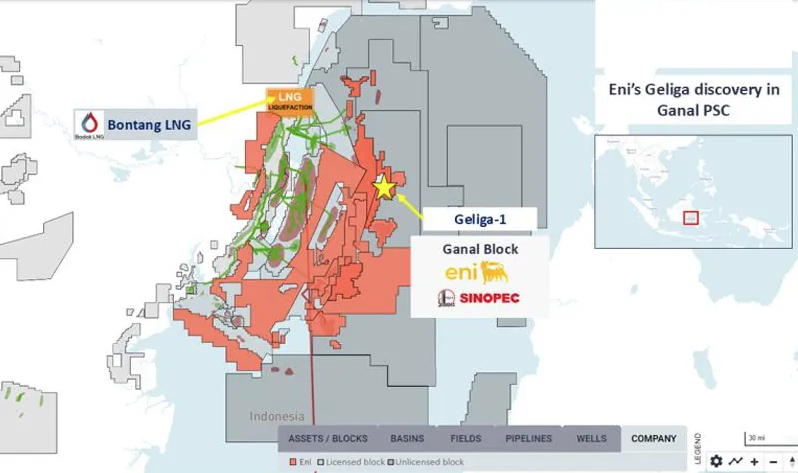
With the major oil and gas discovery at Geliga-1, Sinopec, as the second-largest equity holder of the block, directly benefits from it. This not only serves as the latest testament to the continuously deepening cross-border energy cooperation between the two parties, but also represents an important achievement of their long-term upstream strategic partnership. The Ganal block, where Geliga-1 is located, has been a core strategic investment target for Sinopec for over a decade. Through years of sustained efforts, successive reserve breakthroughs have been realized, fully delivering the value of long-term investment.
Beyond Indonesia, the two parties have deeply interlocked their global upstream portfolios. For example, in the deepwater Block 15/06 offshore Angola, they have jointly carried out exploration and development. Sinopec holds a 26.32% interest in this block and participates in the deepwater oilfield development led by Eni, accumulating full-cycle development experience including deepwater drilling and platform operations, thereby forming a coordinated layout across two major deepwater resource regions in Asia and Africa. Moreover, their cooperation extends to the refining sector, where Eni has transferred its advanced EST (slurry bed residue hydroconversion) patented technology to Sinopec for implementation at the Maoming refining and chemical complex, enabling efficient upgrading of heavy crude oil and achieving upstream-downstream technological complementarity.
Post time: Apr-23-2026