
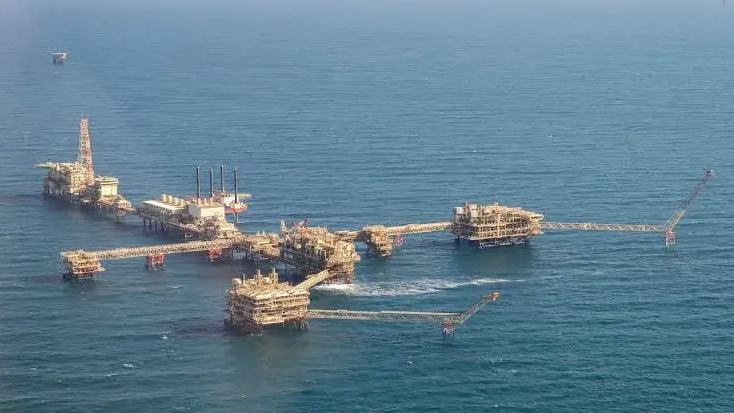
Recently, Abu Dhabi National Oil Company (ADNOC) officially made the Final Investment Decision (FID) for the Umm Shaif gas cap development project, with a total investment of $6.2 billion (approximately RMB 42 billion). A gas cap refers to a layer of natural gas accumulation; in hydrocarbon reservoirs, oil, gas, and water are vertically distributed by density, with the lightest natural gas occupying the top of the trap to form the gas cap.
This decision not only bears on the UAE’s domestic energy security, but also places a very significant piece on the board at a critical juncture when the global natural gas market landscape is being reshaped.
01. $6.2 Billion – A Strategic Move to Revitalise a “Mature Oil Field”
The Umm Shaif field is Abu Dhabi’s oldest offshore oil and gas asset – discovered in 1958 and producing the UAE’s first export crude oil in 1962. After more than six decades of oil extraction, the natural gas resources above it (i.e., the gas cap) have remained undeveloped systematically. This $6.2 billion investment is precisely aimed at unlocking this long‑”dormant” resource.
Upon completion, the project is expected to produce over 600 million standard cubic feet per day (about 600 MMscfd) of natural gas and associated condensates, equivalent to nearly 10% of the UAE’s current daily natural gas consumption. The project is scheduled to officially commence production in 2030.
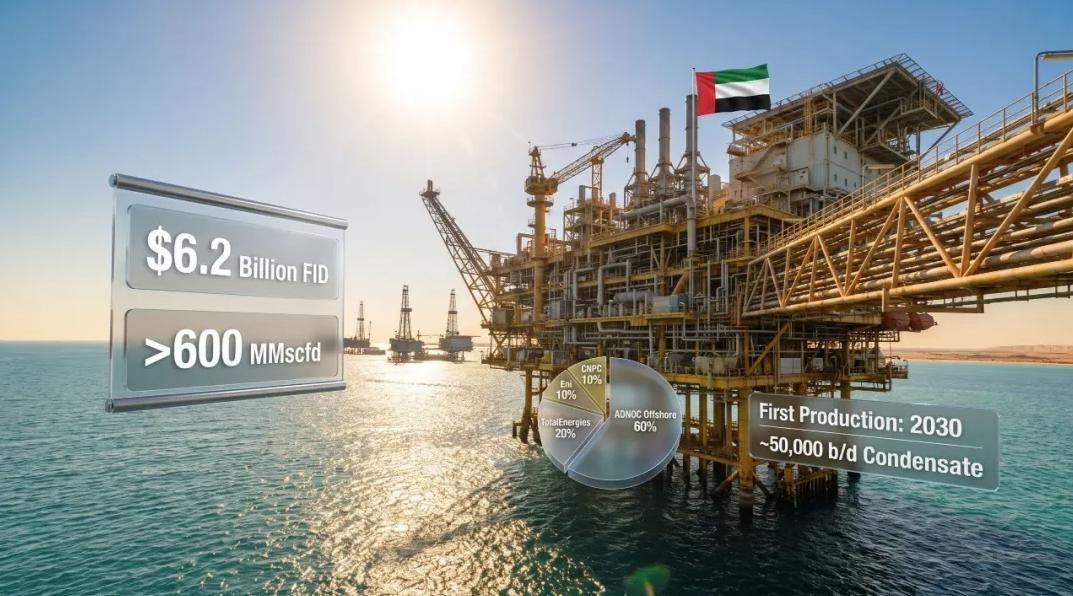
In terms of investment composition, the $6.2 billion is mainly divided into two parts: first, three Engineering, Procurement, and Construction (EPC) contracts totaling approximately $5.1 billion, for the construction of new large‑scale offshore infrastructure; and second, a $365 million drilling and integrated drilling services program, under which ADNOC Drilling will complete 14 wells over 18 months using three existing offshore platforms. It is worth noting that the project will make full use of existing offshore facilities and electricity from the UAE’s national grid to reduce development costs and carbon emissions.
Notably, from a longer‑term strategic perspective, the Umm Shaif gas cap project is only one piece of ADNOC’s broader gas portfolio. Prior to this, the UAE’s Supreme Council for Financial and Economic Affairs had already awarded the Bab gas cap concession agreement, which is expected to unlock an additional 1.5 billion standard cubic feet per day of natural gas and condensates. And as recently as early July 2026, ADNOC launched its global LNG marketing and trading platform on the Abu Dhabi Global Market (ADGM), targeting a total marketable LNG capacity of 47 million tonnes per annum by 2035 – a scale sufficient to position Abu Dhabi among the world’s leading LNG suppliers.
Dr. Sultan Ahmed Al Jaber, ADNOC’s Managing Director and Group CEO, clearly stated: “As global demand for natural gas continues to rise, ADNOC is accelerating its integrated gas strategy, further developing the UAE’s abundant gas resources and expanding its global LNG platform.” This statement clearly outlines ADNOC’s strategic intent: to leverage domestic upstream resources and use the LNG trading platform as a lever to gain greater say in the global natural gas market.
02. CNPC Takes a 10% Stake
The equity structure of the Umm Shaif gas cap project is as follows: ADNOC Offshore holds a 60% interest and acts as the operator, TotalEnergies holds 20%, while Eni and China National Petroleum Corporation (CNPC) each hold 10%. Based on the total investment, CNPC’s corresponding contribution is approximately $620 million.
CNPC’s cooperation with ADNOC is not a recent development. Since acquiring a 10% interest in the Umm Shaif and Nasr concession in 2018, CNPC has continued to be deeply involved in the exploration and development of the block. Earlier, in 2017, CNPC signed the “Abu Dhabi Onshore Oilfield Development Cooperation Agreement” with ADNOC, obtaining a partial interest in the onshore oil block – marking the first time a Chinese company acquired upstream assets in a GCC country. In March 2018, the two sides again joined hands in the offshore Umm Shaif‑Nasr and Lower Zakum projects. Since then, CNPC has been fully participating in the exploration, development and operation management of four projects in the UAE.
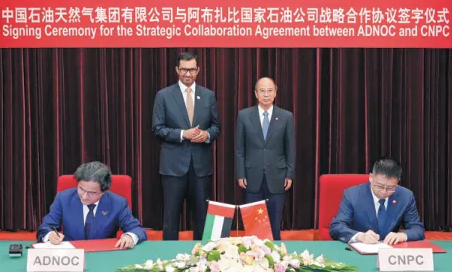
Since then, the cooperation between the two sides has continued to deepen — in 2025, they established a Strategic Cooperation Steering Committee, formally putting in place a regularized strategic cooperation working mechanism, and setting up specialized working groups covering low‑carbon solutions, oil and gas exploration and development, advanced technology exchange, refining business cooperation, and sales and trading.
Post time: Aug-06-2026