
In recent days, PETRONAS, Malaysia’s national oil company, announced its latest exploration results offshore Suriname—two new discoveries and one successful appraisal well, bringing the total number of successful wells in Block 52 to eight, and unlocking cumulative recoverable resources of over 1 billion barrels of oil equivalent.
01. PETRONAS achieves another breakthrough in Suriname
In PETRONAS’s latest drilling activities in Suriname, there are many highlights: the Caiman‑1 exploration well, at water depth 90 meters, drilled to total depth 5,065 meters, encountered multiple oil‑bearing Cretaceous sandstone intervals; the Swartzia Aspasia Complex‑1 (SAC‑1) exploration well, located about 8 km east of the Sloanea‑1 gas discovery, at water depth 610 meters, drilled to total depth 4,560 meters, encountered gas‑bearing sandstone reservoirs, and drill‑stem testing confirmed strong natural gas productivity and good reservoir quality; in addition, the Roystonea‑2 appraisal well, located about 7 km north of Roystonea‑1, confirmed the lateral distribution extent of the oil‑bearing reservoir, and testing indicated strong crude oil productivity.
Thus far, all eight wells drilled by PETRONAS in Block 52 have been successful – including Roselle‑1, Sloanea‑1, Roystonea‑1, Fusaea‑1, Sloanea‑2, Caiman‑1, SAC‑1 and Roystonea‑2 – with a success rate as high as 100%.
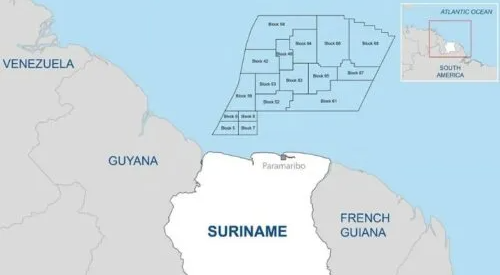
PETRONAS, as the operator of Block 52, holds an 80% interest, while the remaining 20% is held by Paradise Oil Company, a wholly‑owned subsidiary of Staatsolie, Suriname’s national oil company.
Previously, PETRONAS had already made a discovery in Suriname – finding the Sloanea gas field, and in November 2025 decided to commercialise it. PETRONAS plans to develop the Sloanea gas discovery through an integrated Floating Liquefied Natural Gas (FLNG) project, with a final investment decision expected to be made by the end of 2026.
PETRONAS Chief Operating Officer Mohd Jukris Abdul Wahab said: “Our eight successful wells in Suriname have unlocked recoverable resources exceeding 1 billion barrels of oil equivalent, reflecting our technical strength, rigorous execution and strong partnerships in Suriname.”
02. The new oil upstart rising from South America’s “Golden Belt”
Suriname’s current oil and gas boom cannot be separated from the “demonstration effect” of its neighbour, Guyana.
Over the past decade, the Stabroek block in Guyana alone has discovered more than 13 billion barrels of oil equivalent in oil and gas reserves. ExxonMobil, as the operator of the block (holding 45% interest), has so far accumulated 46 discoveries in the block, with crude oil production exceeding 900,000 barrels per day. With key projects coming on stream in 2026, Guyana’s daily oil production will surpass 1.1 million barrels. The Stabroek block has proven recoverable oil and gas resources of over 11 billion barrels of oil equivalent, and after all 10 planned floating production storage and offloading (FPSO) vessels are put into operation, the block’s total production will reach 1.5 million barrels per day.
Guyana’s oil miracle has drawn much attention to Suriname, which shares the same geological basin with it. The Suriname-Guyana basin has high geological similarities, and international energy research institutions generally believe that Suriname has oil and gas potential comparable to that of Guyana.
Rystad Energy forecasts that capital investment in Suriname’s upstream sector will reach $9.5 billion between 2025 and 2027. Wood Mackenzie further points out that in 2025, Suriname surpassed Guyana for the first time to become the country with the highest number of offshore oil and gas exploration and appraisal wells drilled in the region.
Such an attractive prospect naturally attracts the scramble of global oil giants —
TotalEnergies operates the GranMorgu project in Block 58, with an investment of up to $10.5 billion, and it is expected to come on stream in 2028, becoming Suriname’s first large‑scale deepwater offshore oil field. TotalEnergies also plans to launch a new round of multi‑well drilling in Block 58 in 2027. So far, TotalEnergies has discovered about 1.6 billion barrels of oil equivalent in Block 58.
APA Corporation cooperates with TotalEnergies in developing Block 58 (holding 40% interest), and at the same time has identified about 100 million barrels of oil equivalent in Block 53; Shell plans to spud the Araku Deep‑1 well in Block 65, which is the first of its four wells in Suriname; Chevron has long conducted exploration in the offshore mountainous blocks of Suriname and has signed a production sharing contract with Staatsolie; QatarEnergy has signed production sharing contracts for Blocks 9 and 10 in Suriname, and has taken over Chevron’s 20% interest after its exit and acts as operator in Block 5.
PETRONAS executives have also clearly stated that Block 52 is located within the highly prospective “Golden Belt” corridor, and this national oil company is focused on converting this resource base into long‑term value for Suriname and the company itself.
On this “Golden Belt” in South America, the layout of Chinese oil and gas enterprises cannot be ignored either. CNOOC is the earliest and most fruitful one. Through its wholly‑owned subsidiary CNOOC Petroleum Guyana Limited, CNOOC holds 25% interest in the Stabroek block in Guyana. With total recoverable resources of over 11 billion barrels of oil equivalent in the Stabroek block, CNOOC has thus reaped rich returns from the world’s most commercially attractive emerging oil and gas province. The Guyana basin has become CNOOC’s largest overseas upstream asset investment destination.
PetroChina has set its sights directly on Suriname. In September 2024, PetroChina officially signed production sharing contracts for the shallow water Blocks 14 and 15 in Suriname, holding 70% contract interest and serving as operator, which is the first time a Chinese company has obtained operatorship of oil and gas blocks in Suriname. These two blocks are located in the shallow water area in the eastern part of the Suriname‑Guyana basin, with water depths ranging from 50 to 150 meters. PetroChina has started 3D seismic acquisition operations, and Staatsolie holds the remaining 30% interest through its subsidiary.
From Guyana’s billion‑barrel‑level discoveries to Suriname’s accelerated catch‑up, this “Golden Belt” in South America is reshaping the global deepwater oil and gas landscape. PETRONAS’s 1 billion‑barrel breakthrough is just the beginning – with TotalEnergies’ GranMorgu project coming on stream in 2028, the continued exploration by giants such as Shell and Chevron, and the deep involvement of Chinese oil and gas enterprises, Suriname is expected to become another shining oil upstart in South America, following Guyana.
Post time: Jul-07-2026