
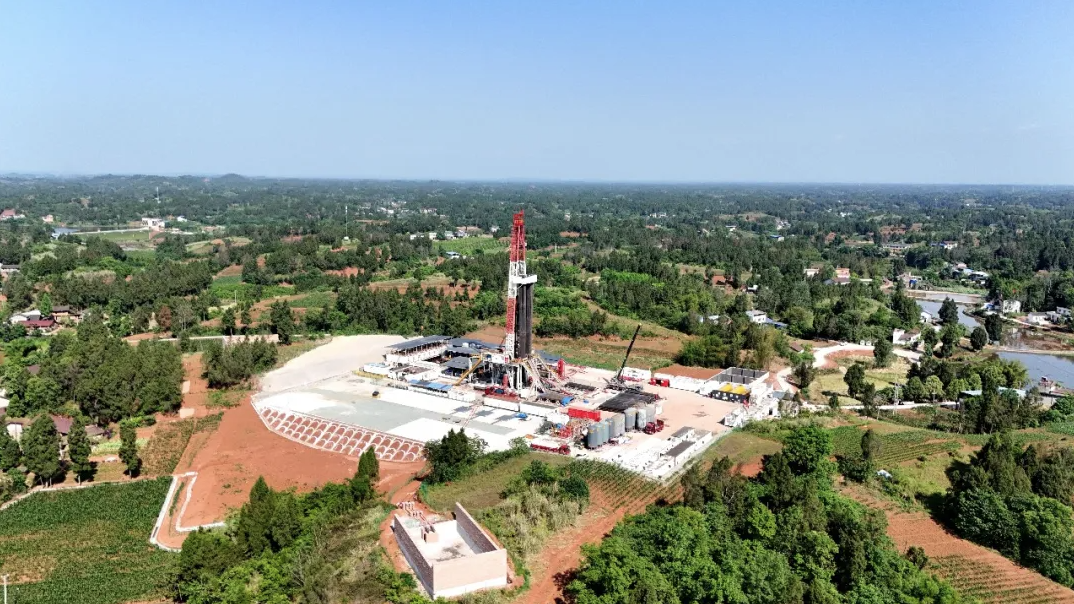
On May 13, according to the news office of Sinopec, Sinopec’s “Deep Earth Project · Sichuan-Chongqing Natural Gas Base” achieved another breakthrough. The Ministry of Natural Resources released the mineral exploration results: the proved geological reserves of 235.687 billion cubic meters from the Dongfeng shale gas field in Ziyang, Sichuan, submitted by Sinopec Southwest Oil & Gas Branch, have been approved by the expert panel of the Ministry of Natural Resources. This marks the birth of an ultra-deep, hundred-billion-cubic-meter-level shale gas field in China, successfully advancing shale gas exploration and development into the new ultra-deep realm of burial depths exceeding 4,500 meters. It represents a strategic leap of China’s shale gas from deep to ultra-deep layers, and is a milestone in further consolidating the foundation of national energy security and expanding the strategic replacement space for large-scale reserve growth and production increase.
The Ziyang Dongfeng shale gas field is located in the Sichuan Basin and is a large, fully integrated gas field discovered within the Cambrian Qiongzhusi Formation shale sequence. The Cambrian shale represents the oldest shale sequence in the world to have achieved large-scale discoveries, having formed 540 million years ago. With burial depths ranging from 4,500 to 5,200 meters, it presents enormous engineering challenges due to unclear reservoir characteristics, unknown mechanisms of hydrocarbon accumulation and enrichment, thick and difficult-to-drill strata, as well as high temperatures and high pressures. Consequently, its exploration and development are recognized as a world-class challenge.
Innovations have been made in geological theories and breakthroughs achieved in key core technologies. In terms of theoretical understanding, the research team broke free from the limitations of previous shale gas exploration concepts, developed an innovative understanding of the accumulation and enrichment of shale gas in the Cambrian Qiongzhusi Formation, and opened up a brand new strategic replacement frontier for shale gas. In terms of technological breakthroughs, artificial intelligence has been integrated into the geophysical exploration technology system — much like performing a CT scan on underground strata — enabling “clear identification of reservoirs and visibility of gas accumulations.” At the same time, breakthroughs have been made in ultra‑deep shale gas drilling, fracturing, and other technologies, culminating in a fully self‑developed technological system for the exploration and development of ultra‑deep Cambrian shale gas.
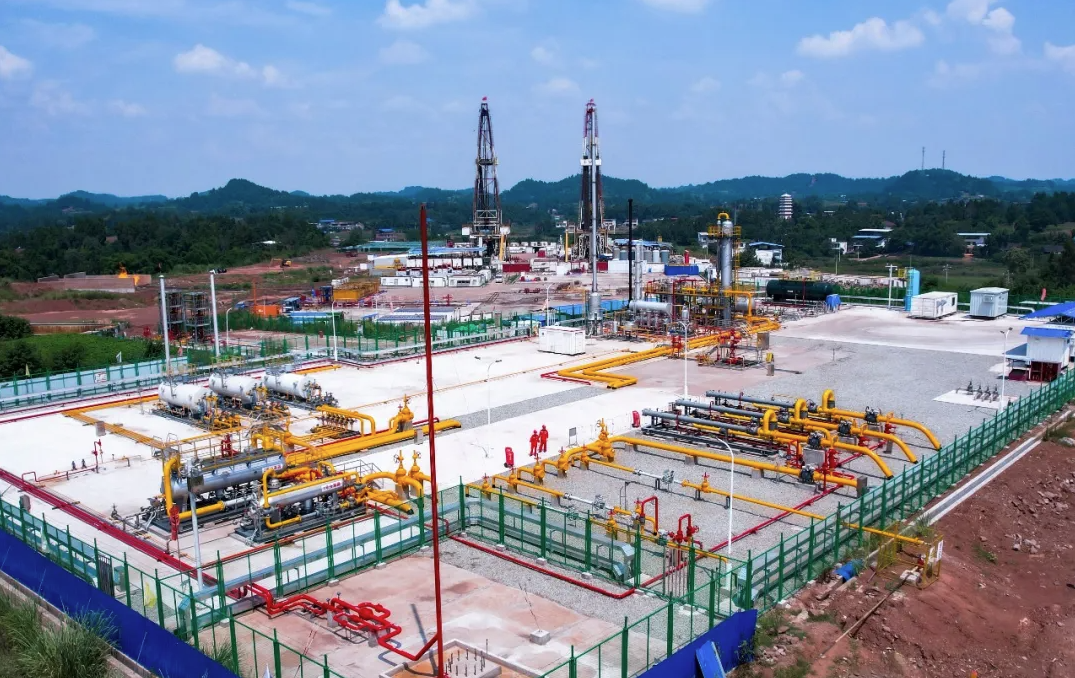
Liu Wei, Director of the Board and Party Secretary of Sinopec Southwest Petroleum Bureau Co., Ltd., and Representative of Sinopec Southwest Oil & Gas Branch, said that after more than ten years of intensive efforts and continuous research, the company has achieved a leap in Cambrian Qiongzhusi Formation shale gas from “zero” to “hundred‑billion‑cubic‑meter scale reserves.” This confirms that this shale sequence has significant potential for large‑scale development. A replicable and transferable technological path has been established, greatly expanding the scope of shale gas resource development in China. Going forward, the company will continue to advance high‑quality exploration and efficient development of oil and gas resources, accelerate the increase of reserves and production at the Ziyang Dongfeng shale gas field, and contribute to safeguarding national energy security.
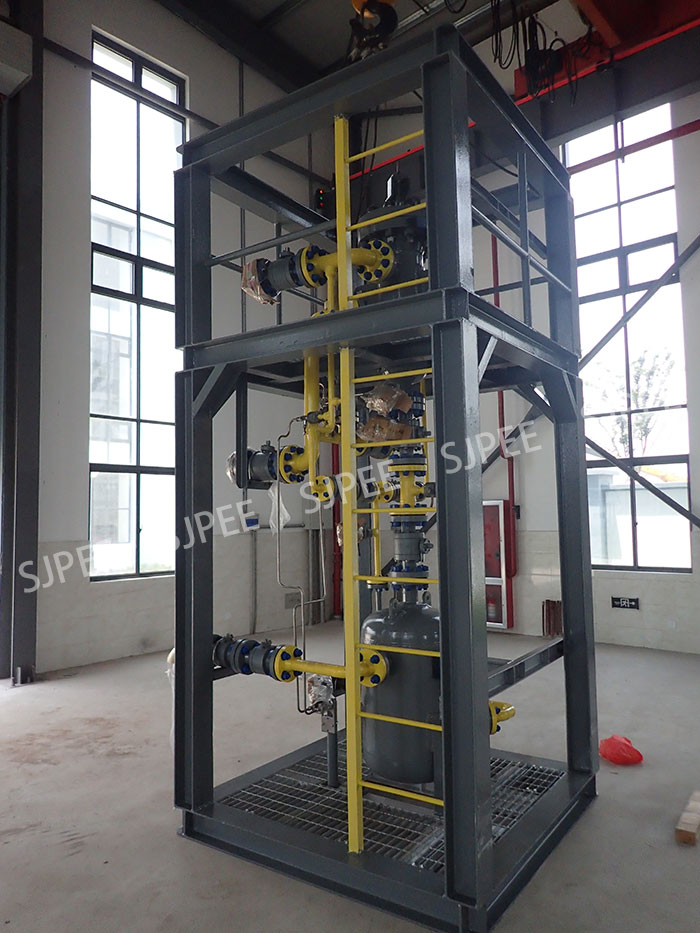
Shale gas production requires essential sand removal equipment like desanders.
Shale gas desanding refers to the process of removing solid impurities such as sand grains, fracturing sand (proppant), and rock cuttings from shale gas streams (with entrained water) through physical or mechanical methods during shale gas extraction and production.
As shale gas is primarily obtained through hydraulic fracturing technology (fracturing extraction), the returned fluid often contains large amounts of sand grains from the formation and residual solid ceramic particles from fracturing operations. If these solid particles are not completely separated early in the process flow, they would cause severe erosion to pipelines, valves, compressors and other equipment, or lead to pipeline blockages in low-lying sections, clogging of instrument pressure guide pipes, or trigger production safety incidents.
SJPEE’s shale gas desander delivers exceptional performance with its precision separation capability (98% removal rate for 10-micron particles), authoritative certifications (DNV/GL-issued ISO certification and NACE anti-corrosion compliance), and long-lasting durability (featuring wear-resistant ceramic internals with anti-clogging design). Engineered for effortless efficiency, it offers easy installation, simple operation and maintenance, along with extended service life – making it the optimal solution for reliable shale gas production.
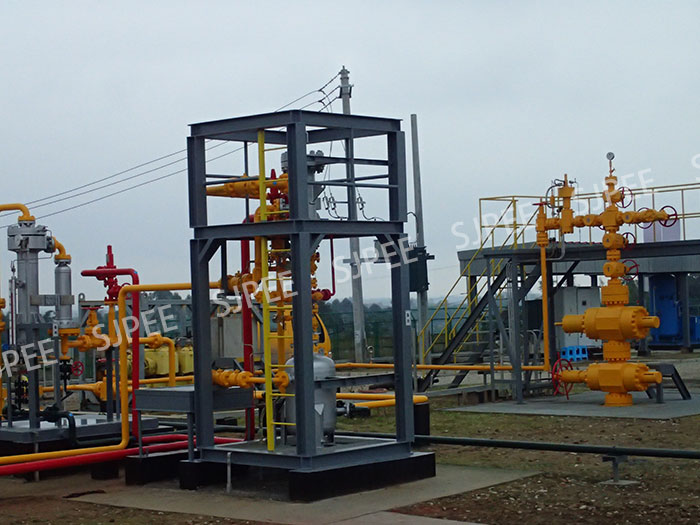
Our company is continuously committed to developing more efficient, compact, and cost-effective desander while also focusing on environmentally friendly innovations.
Our desanders come in a wide variety of types and have extensive applications. In addition to shale gas desanders, such as High-efficiency Cyclone Desander, Wellhead Desander, Cyclonic Well stream crude Desander With Ceramic Liners, Water injection Desander,Natural Gas Desander, etc.
SJPEE’s desanders have been used on wellhead platforms and production platforms in gas and oil fields such as CNOOC, PetroChina, Malaysia Petronas,Indonesia, the Gulf of Thailand, and others. They are used to remove solids in gas or well fluid or produced water, as well as seawater solidification removal or production recovery. Water injection and water flooding to increase production and other occasions.
This premier platform has positioned SJPEE as a globally recognized solution provider in solid control & management technology. We always prioritize our customers’ interests and pursue mutual development with them.
Post time: May-19-2026