
Australian oil and gas producer Santos has lowered its full-year 2026 oil and gas production guidance from 99–105 million barrels of oil equivalent to 99–102 million barrels of oil equivalent, mainly due to production interruptions during the ramp-up of its Pikka oil project in Alaska, the United States, and delays in the commissioning of supporting facilities. Meanwhile, the company’s third-quarter oil and gas production reached a new record of 26.3 million barrels of oil equivalent, up 23% year on year.

The production constraints at the Pikka project involved two operational events. Commissioning of the seawater treatment plant was affected by weather events, leading to short-term production cuts at the field; subsequently, the operator of the Kuparuk pipeline shut the pipeline due to a road accident, causing an interruption in crude oil exports. Affected by these factors, Santos also lowered the upper end of its full-year oil and gas sales volume guidance from 108 million barrels of oil equivalent to 105 million barrels of oil equivalent, while maintaining the lower end at 102 million barrels of oil equivalent.
Pikka had reached its lowest expected plateau level before the end of the third quarter, with daily production briefly exceeding 80,000 barrels. The company decided to temporarily hold daily output at about 70,000 barrels, using seawater injection to supplement reservoir pressure, and then raise it to the target level of 80,000 barrels per day. The project’s seawater injection system had already started reservoir injection on August 26, with seawater transported from the Arctic coast to the field via an approximately 75-km pipeline; injection volume reached about 40,000 barrels per day in September.
Despite short-term disruptions at Pikka, Santos’s overall production and sales continued to grow in the third quarter. Australia’s Barossa gas project entered stable production, boosting LNG supply; new crude oil output from Pikka also began to be included in quarterly results. The company’s third-quarter oil and gas sales reached 26.4 million barrels of oil equivalent, up 11% quarter on quarter, and sales revenue reached USD 2.01 billion, up 78% year on year and 49% quarter on quarter.
Production growth and higher LNG sales prices brought Santos’s third-quarter operating free cash flow to about USD 1.07 billion. Of this, cash flow from Papua New Guinea and Alaska operations contributed more than 50%. The company continues to advance water injection and production adjustments at Pikka while maintaining stable production at Barossa.

The extraction of oil and natural gas cannot be achieved without separation equipment.
Shanghai Shangjiang Petroleum Engineering Equipment Co., Ltd. established in Shanghai in 2016, is a modern technology enterprise integrating R&D, design, production, and service. We are dedicated to developing separation and filtration equipment for the oil, gas, and petrochemical industries. Our high-efficiency product portfolio includes de-oiling/dewatering hydrocyclones, desanders for micron-sized particles, and compact flotation units. We provide complete skid-mounted solutions and also offer third-party equipment retrofitting and after-sales services. Holding multiple proprietary patents and operating under a DNV-GL certified ISO-9001, ISO-14001, and ISO-45001 management system, we deliver optimized process solutions, precise product design, strict adherence to engineering specifications, and ongoing operational support.

Our high-efficiency cyclone desanders, renowned for their exceptional 98% separation rate, have earned recognition from international energy leaders. Constructed with advanced wear-resistant ceramics, these units achieve 98% removal of particles as fine as 0.5 microns in gas streams. This capability enables the reinjection of produced gas for miscible flooding in low-permeability reservoirs, a key solution for enhancing oil recovery in challenging formations. Alternatively, they can treat produced water, removing 98% of particles larger than 2 microns for direct reinjection, thereby boosting water-flood efficiency while minimizing environmental impact.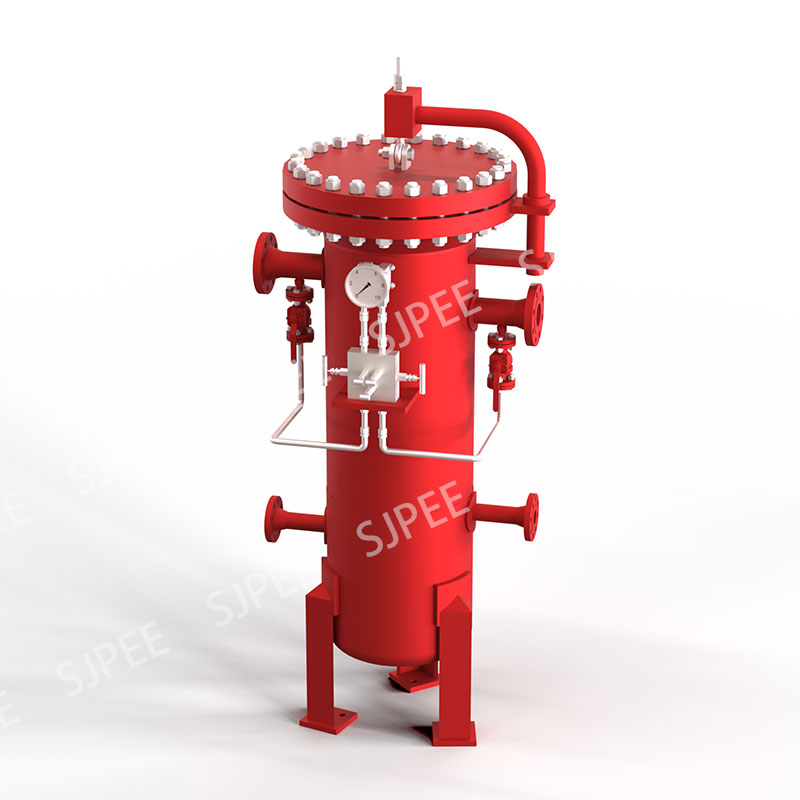
Our new product——The High Efficiency Ultra-Fine Particle Desander is a liquid-solid separation device that utilizes an efficient centrifugal principle to separate suspended impurities—such as solids in produced water, seawater, condensate, fine particles in high-viscosity liquids, and catalyst powder in reactors—from fluids (liquids, gases, or gas-liquid mixtures). It effectively removes solid particles with sizes down to 2 microns (at 98% efficiency) or smaller.
The High Efficiency Ultra-Fine Particle Desander delivers high sand removal efficiency, capable of removing solid particles down to 2 microns. The equipment features a compact footprint, requires no external power or chemical additives, and has a service life of approximately 20 years. It offers online sand discharge capability without the need for production shutdown.
Proven in major global fields operated by CNOOC, CNPC, Petronas, and others across Southeast Asia, SJPEE desanders are deployed on wellhead and production platforms. They provide reliable solids removal from gas, well fluids, and condensate, and are critical for seawater purification, production stream protection, and water injection/flooding programs.
Beyond desanders, SJPEE offers a portfolio of acclaimed separation technologies. Our product line includes membrane systems for natural gas CO₂ removal, deoiling hydrocyclones, high-performance compact flotation units (CFUs), shale gas desanding,Cyclonic dewater package with produced water treatment,and multi-chamber hydrocyclones, delivering comprehensive solutions for the industry’s toughest challenges.
Post time: Oct-22-2026